Wrist Abnormality Detection System
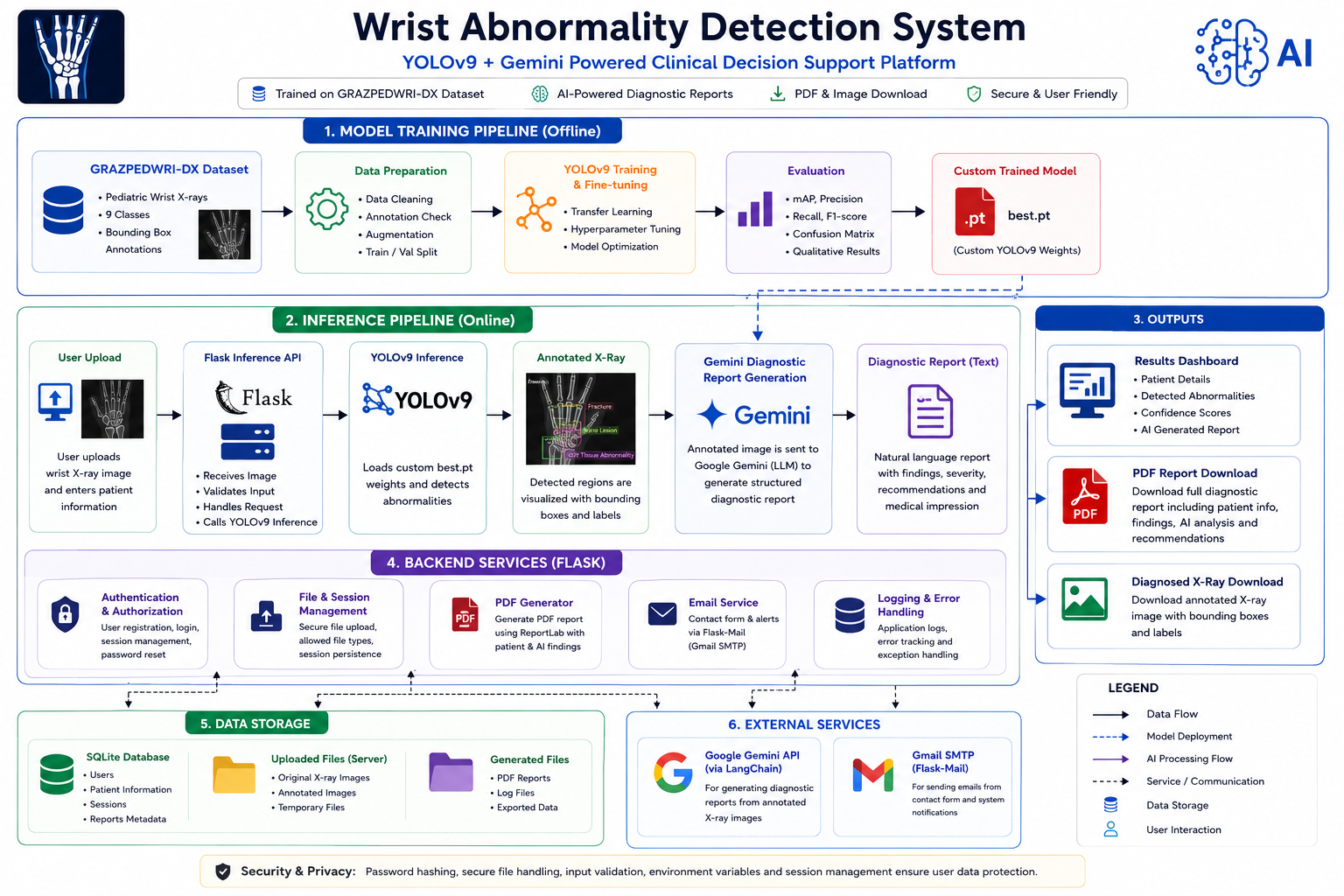
An AI-powered clinical decision support system for wrist X-ray analysis, a custom YOLOv9 model fine-tuned on the GRAZPEDWRI-DX paediatric dataset, a Flask inference API, and automated Google Gemini diagnostic reports with PDF generation.
The problem
Wrist fractures and abnormalities are among the most common paediatric injuries, but accurate X-ray interpretation requires trained radiologists who aren't always immediately available in emergency or rural settings. This system demonstrates how computer vision can provide real-time automated detection of wrist abnormalities, reducing time-to-diagnosis and supporting clinical decision-making with AI-generated structured reports.
What I built
Model training pipeline. I fine-tuned a YOLOv9 model on the GRAZPEDWRI-DX dataset, a large public collection of annotated paediatric wrist X-rays from Graz University. The training pipeline included data preprocessing, image augmentation (rotation, flipping, brightness variation, mosaic augmentation), class balancing, and systematic hyperparameter optimisation to maximise detection performance. Transfer learning from YOLOv9 pre-trained weights significantly accelerated convergence and improved accuracy on the medical imaging domain compared to training from scratch.
Inference API. The trained detection model is served via a Flask inference API that accepts wrist X-ray uploads, runs detection, and returns annotated images with bounding boxes around detected abnormalities. The API handles secure image upload, performs pre-processing (resizing, normalisation), runs the YOLOv9 model, and generates annotated output images for review.
AI-generated diagnostic reports. I integrated Google Gemini to transform the raw detection output (detected classes, bounding box coordinates, confidence scores) into structured diagnostic reports containing clinical findings, severity assessment, and medical recommendations. This demonstrates how LLM capabilities can be combined with computer vision outputs to produce clinician-ready documentation rather than raw model outputs.
Full-stack medical application. The application includes user authentication, session management, SQLite for storing patient information and uploaded images, PDF report generation using the annotated image and Gemini diagnostic output, and an admin dashboard for managing cases and viewing historical detections.
Tech stack
Related services
Building a medical imaging or CV system?
I can train custom object detection models for specialised domains, build inference APIs, and integrate LLMs to turn model outputs into human-readable reports.